
Data piece · Published August 1, 2026
Downstream
Following one hundred dollars of “small” spending to where it actually lands.
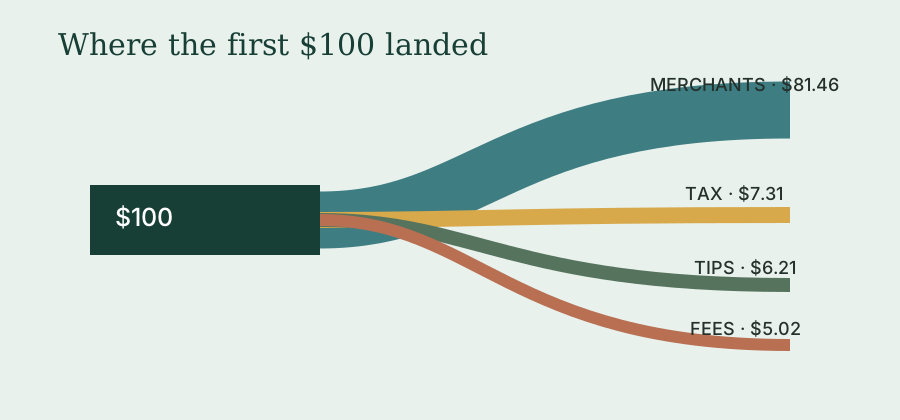
Answer first: Our $100 basket of ten small purchases delivered $81.46 to merchants before their costs, $7.31 to sales taxes, $6.21 to tips, and $5.02 to visible platform or service fees. The exercise did not reveal a villain. It revealed how a forgettable total is assembled—and which parts a buyer can change.
Between July 6 and July 24, 2026, we assembled ten ordinary purchases that totaled exactly $100 after tax and tips: coffee, a bakery stop, parking, a delivery fee, a digital rental, two snacks, transit, a convenience-store item and a small household purchase. We retained itemized receipts and separated visible charges.
This is a case study, not a claim about the entire economy. Merchant revenue is not profit, and a receipt cannot reveal payroll, rent, ingredients or payment-processing agreements. Still, following the visible dollars is more useful than describing all small spending as a leak.
The basket
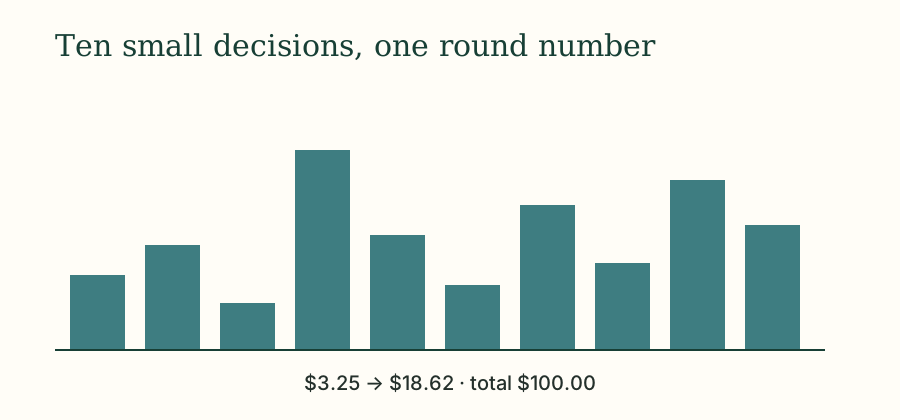
The largest purchase was $18.62 for delivery food; the smallest was $3.25 for parking. Median purchase size was $8.41. Six decisions happened while away from home, three were digital and one was planned. The total felt lighter than a single $100 checkout because no transaction asked for a serious decision.
| Purchase group | Count | Total paid | Tax, tip or fee |
|---|---|---|---|
| Prepared food and drink | 4 | $43.78 | $8.92 |
| Transport and parking | 2 | $11.75 | $0.80 |
| Digital rental and service | 2 | $16.46 | $2.31 |
| Convenience retail | 2 | $28.01 | $6.51 |
| Total | 10 | $100.00 | $18.54 |
$81.46 reached merchants first
Receipts identified $81.46 as merchandise or service subtotal. That is gross merchant revenue before card costs, wages, inventory, rent, insurance, waste and tax on business income. It would be wrong to call it owner profit. The bakery’s $6 subtotal and a digital platform’s $6 subtotal support entirely different cost structures.
The useful consumer observation is simpler: choosing the merchant changes who receives that first share. Buying in person rather than through a delivery marketplace shifted $3.49 of one test purchase away from visible fees. Buying from a neighborhood shop did not make the coffee cheaper, but it changed the first destination.
$7.31 became sales tax
Tax varied by product and location. Two items carried no sales tax, while prepared food and a digital rental did. We report the receipt amount, not an inferred universal rate. A budget category often folds tax into “dining” or “shopping,” which is correct for cash planning but hides why two identical shelf prices may produce different totals.
$6.21 became tips
Three purchases included voluntary tips: $1.20, $2.01 and $3.00. The $6.21 did not land in a generic “merchant” bucket, though exact distribution depends on workplace policy and applicable law. Tips were 14.2% of prepared-food spending and 6.21% of the full basket.
Tips are not surprise leakage when they are part of how a person intends to buy a service. A more honest plan includes them in the expected price. Our plain-English money glossary calls variable expenses changeable, not optional.
$5.02 paid visible fees
The basket included a $2.99 delivery fee, $1.49 service fee and $0.54 digital transaction fee. A “$12” delivery order became $18.62 after tax, tip and fees. The fee share looked small across $100 and large within that one decision. Percentages depend on the denominator chosen.
The part downstream that receipts cannot show
Merchants pay card processors, suppliers, landlords, utilities and workers. Platforms may remit some fees to couriers or retain them. Public averages cannot accurately allocate our particular $81.46, so we stop the trace where documentation stops. Precision without access would be decoration.
This limit matters for budgeting-app data too. A transaction feed knows amount, merchant and time; it rarely knows who benefited or why the purchase was made. Read our manual tracking diary for the information that appeared only when a person added context.
What the $100 changes
We would not ban the basket. The delivery fee bought time during a late workday, parking enabled an appointment and the digital rental replaced a more expensive outing. Two snacks and one service charge were forgettable. If repeating this basket monthly, we would keep $72, plan $18 and remove $10.
The lesson is not that small purchases secretly ruin lives. It is that a round $100 contains different kinds of value and different routes. Tracking the route makes selective change possible. For a tool that helps surface repeated merchants, our Simplifi review explains watchlists without turning every coffee into a moral event.
Timing supplied another clue. Seven of ten purchases occurred within two hours of another activity: commuting, an appointment, a meeting or an errand. Only the digital rental began as the day’s plan. For our August budget, we attached a $25 convenience allowance to travel and errand days instead of pretending those dollars belonged nowhere.
That adjustment respects the evidence. A category called “miscellaneous” would preserve the arithmetic and discard the situation. Following money downstream should work in both directions: toward its recipients and back toward the conditions that put a buyer in front of them.
Frequently asked questions
Are small purchases bad for a budget?
No. The July 2026 basket bought convenience, transport and leisure. The useful question is whether repetition matches priorities, not whether each purchase is small.
Is merchant revenue the same as profit?
No. Our $81.46 subtotal reached merchants before wages, inventory, rent, processing and other costs. Receipts do not support a reliable profit estimate.
How can I trace my own $100?
Keep itemized receipts until purchases total $100, then separate subtotal, tax, tip and visible fees. Add a short note about what each purchase bought in time, access or enjoyment.