
Review · Tested 32 days · Updated August 5, 2026
Copilot Money review: polish with a price
The finest transaction-review habit we tested lives inside an expensive, Apple-centered garden.
Verdict: Copilot Money is an excellent budgeting and net-worth app, scoring 4.5/5 after 32 days. Its fast transaction review, strong rules and beautiful Apple apps make money upkeep feel lighter. Simplifi remains our top pick because it costs less, plans cash flow better and supports more platforms.
4.5 / 5 · Strong recommendation
We connected five financial institutions and observed 187 transactions. Copilot assigned a useful first category to 180, or 96.3%, the best uncorrected result in this test round. Seven errors involved a payment processor, two transfers and mixed-purpose big-box purchases. More important than the raw rate, Copilot made correction fast: review, swipe, confirm the rule, continue.
This is not zero-based budgeting. Copilot watches spending by category, tracks recurring items, shows cash flow and consolidates net worth. It helps answer “What has changed?” faster than “What may I safely spend before next payday?” That difference explains why our Quicken Simplifi review ends with the higher score.
What worked
- Best transaction review in our test
- Excellent rule creation
- Polished iPhone and Mac apps
- Clear spending and net-worth views
What did not
- $95 annual price
- No standard Android experience
- No conventional browser app
- Household collaboration is limited
Our weighted score
| Category | Weight | Score | Weighted points |
|---|---|---|---|
| Tracking accuracy | 25% | 4.9 | 1.23 |
| Planning tools | 25% | 4.2 | 1.05 |
| Daily usability | 20% | 5.0 | 1.00 |
| Price and value | 15% | 3.7 | 0.56 |
| Privacy and support | 15% | 4.5 | 0.68 |
| Total | 100% | — | 4.51 / 5 |
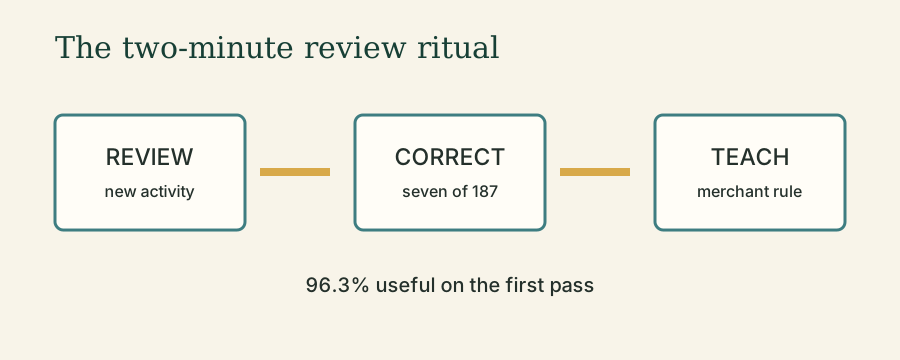
The daily review is the product
Most money apps treat uncategorized transactions as chores waiting in a queue. Copilot turns them into a short, coherent ritual. The app presents new activity, lets you confirm or change categories quickly and learns merchant rules without burying them. Our review usually took under two minutes each morning. By week three, nearly every correction represented real ambiguity rather than a preventable software mistake.
The visual design contributes more than decoration. Spending changes are legible without opening three panels, recurring charges have a distinct home, and month-to-month comparisons stay calm. Good interface design reduces avoidance. That matters in personal finance because a theoretically powerful tool is useless when opening it feels like beginning a tax return.
Planning is capable, but backward-looking
Copilot supports category budgets and rollover settings, and its cash-flow view separates income from spending cleanly. Yet its center of gravity remains the transaction stream and current month. Simplifi’s projected balance is more explicit about the sequence of future paychecks, bills and transfers. YNAB is more deliberate about assigning available money before it is spent.
None of this makes Copilot shallow. Recurring-item detection was accurate after we corrected two annual charges, and net-worth tracking included property and manual assets. Investment views were sufficient for overall allocation and changes, not serious portfolio analysis. The app is an attentive household dashboard, not accounting software.
The Apple boundary is real
Copilot’s native iPhone and Mac apps are a pleasure, but product fit depends on who shares the finances. A single iPhone user with a Mac gets the intended experience. An Android partner or a person who manages money from a work PC does not. Platform limits are not a minor feature omission; they determine whether both people can participate without friction.
Our head-to-head comparison gives Copilot the usability category and Simplifi the availability, planning and value categories. If Copilot expands its first-class platform support, the contest becomes closer. In August 2026, Simplifi remains the safer household recommendation.
Price is the hardest objection
As checked August 5, 2026, the official Copilot Money site listed $13 per month or $95 per year. The annual plan averages about $7.92 monthly and saves $61 compared with twelve monthly payments. There is no permanent free tier. Trials and promotions can change.
That $95 can be reasonable if it buys consistent awareness, especially for someone leaving a neglected spreadsheet or a more expensive service. It is harder to defend for passive balance aggregation. Monarch’s annual list price sits in a similar range and provides a stronger household orientation; Simplifi’s regular annual price is lower. Our 2026 app ranking lays out those tradeoffs.
Who will love Copilot?
Choose it if you live on Apple devices, care about visual clarity and want to spend two deliberate minutes reviewing money most days. Its mix of automation and confirmation is especially good for people who distrust fully automatic budgets but do not want manual entry. It is also a strong Mint replacement for users whose priority is a unified, attractive financial dashboard.
Skip it if a partner needs Android or browser access, if $95 a year feels irritating before you begin, or if your primary need is forward planning around variable pay dates. Start with our budgeting app decision guide if you are unsure which of those needs actually matters.
Frequently asked questions
How much does Copilot Money cost in 2026?
As checked August 5, 2026, Copilot Money cost $13 per month or $95 per year after its trial. The annual plan works out to about $7.92 monthly. Pricing and trial terms can change, so verify the amount shown inside the official app before subscribing.
Does Copilot Money work on Android or the web?
Copilot is built around iPhone, iPad and Mac. It does not offer the conventional Android and browser access that makes Simplifi easier to recommend for mixed-device households. Check the official compatibility listing before joining because platform availability is a meaningful part of this purchase.
Can couples share Copilot Money?
Couples can include joint and individual accounts in one financial view, but Copilot is not fundamentally a multi-user household system with granular roles. A pair can share a login and data, yet households wanting separate credentials and broader device support may find Simplifi or Monarch more natural.
Is Copilot Money better than Simplifi?
Copilot is better at interface polish and the daily transaction-review ritual. Simplifi is better at forward cash-flow planning, price, browser access and Android availability. We scored Copilot 4.5/5 and Simplifi 4.8/5, making Simplifi our narrower but more broadly useful winner.